At a time when everyone is looking for suitable housing, buying a first home is a significant step that many must face. Especially for Khun Amnat, a middle-aged man who has just decided to purchase a house in a rapidly growing area. However, he found that buying a house was not as easy as he thought when he encountered taxes and transfer fees that had to be paid. Despite being well-prepared, there were still many unexpected issues. This is an important lesson that every homeowner should learn to avoid complications in the real estate transaction process.
Understanding taxes and transfer fees is just as important as choosing the location or type of house because these costs can quickly turn a dream into a burden. Good preparation and learning about the relevant taxes will help homebuyers plan their finances effectively and avoid surprises when the time comes. Therefore, in this article, we will explore the taxes and transfer fees that everyone should know to make buying a first home not just a dream, but a smoothly realized reality.
Key Points Summary
- Get to know the taxes and fees related to property ownership transfer
- Understand how to calculate the taxes payable when buying or selling houses and condos
- Learn strategies to reduce taxes and transfer fees to save costs
- Explore case studies from real buyers and sellers of real estate in Thailand
- Be prepared for ownership transfer and managing related documents
Case Study of Khun Amnat: Buying His First Home
Khun Amnat is a 35-year-old man working at a private company in Bangkok. He decided to purchase his first home in the Lat Phrao area, priced at 4,500,000 baht. After saving a down payment of 1,000,000 baht, Khun Amnat began researching taxes and fees related to buying a house—something he had never anticipated facing during this process.
First Experience
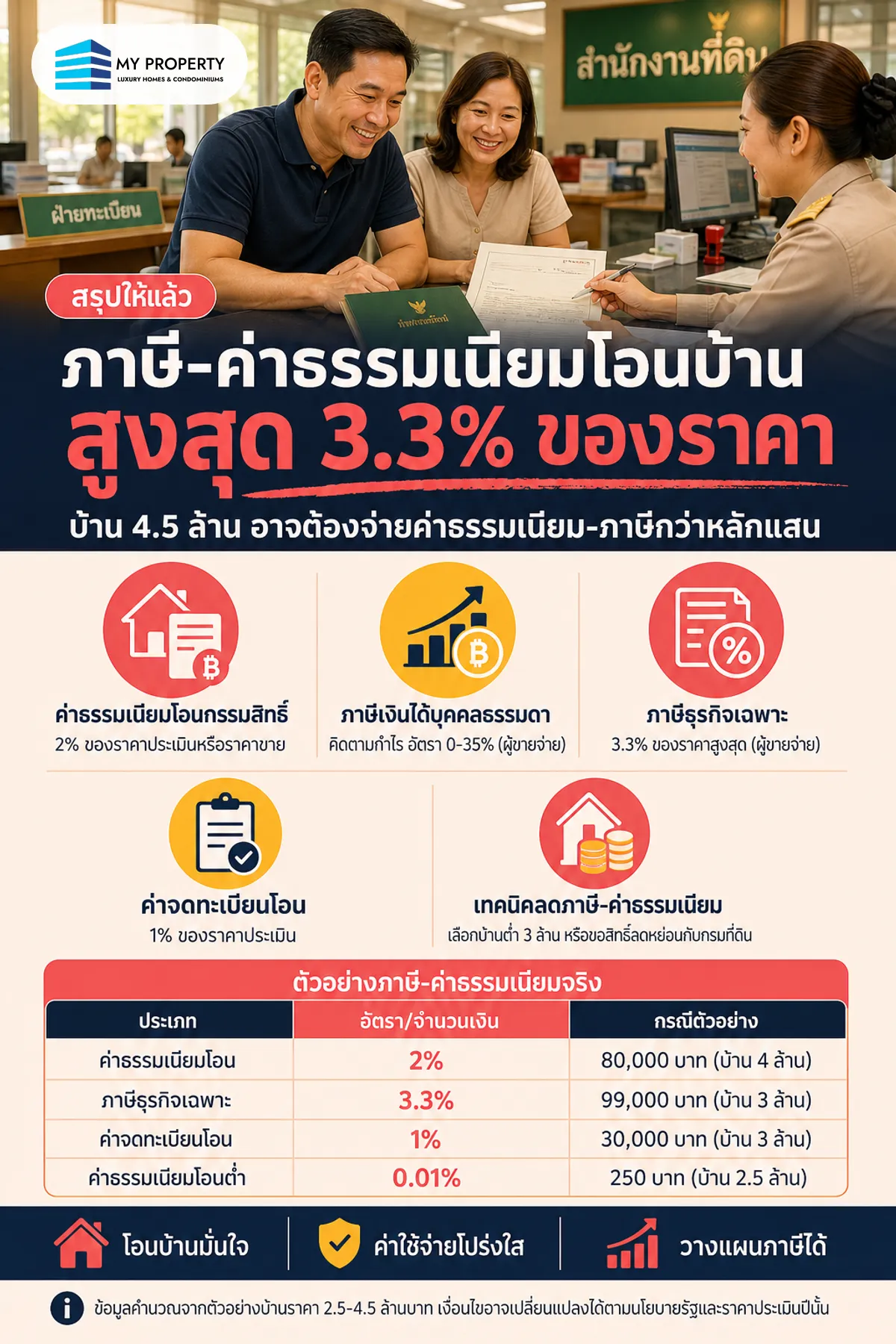
After negotiating the purchase with the homeowner, he received information about the taxes and transfer fees he needed to pay, such as the ownership transfer fee, which is 2% of the appraised value or the sale price (whichever is higher), as well as other possible taxes like personal income tax and specific business tax.
Taxes and Fees to Pay
For this house, the appraised value is 4,000,000 baht, so Khun Amnat must pay a transfer fee of 80,000 baht (2% of 4,000,000 baht). Additionally, he needs to calculate personal income tax based on the profit from the sale, which in this case, if the original owner is the seller, requires a more complex calculation.
Preparation and Consulting Experts
Khun Amnat felt uncertain about calculating the various taxes and fees, so he consulted with lawyers and real estate experts to obtain accurate and comprehensive information. He found that if he could manage the documents and calculations correctly, it would significantly reduce future expenses.
From Khun Amnat’s experience, he learned that preparation and understanding of taxes and transfer fees are crucial to ensuring a smooth home-buying process, especially for first-time buyers who lack prior experience in this area.
Types of Taxes Related to Real Estate Transactions
When buying and selling real estate in Thailand, buyers need to prepare for various types of taxes involved. It is important for homeowners to be aware of these to ensure smooth and efficient transactions.
Personal Income Tax
Personal income tax is payable by the seller if there is a profit from the sale of the property. This tax is calculated by deducting the cost price and related expenses from the sale price. The tax rate ranges from 0% to 35%, depending on the seller’s income level.
For example, if Khun Amnat sells a house for 3,000,000 baht, with a cost price of 2,000,000 baht and related expenses of 200,000 baht, the personal income tax payable would be calculated as follows:
Taxable profit = 3,000,000 - 2,000,000 - 200,000 = 800,000 baht
According to the specified tax rate, a 20% tax may be due, amounting to 160,000 baht.
Specific Business Tax
Specific business tax must be paid by sellers who conduct real estate transactions as a business. The tax rate is 3.3% of the sale price or the Land Department’s appraised value, whichever is higher.
If Khun Amnat sells a house for 3,000,000 baht, the specific business tax payable would be:
Specific business tax = 3,000,000 * 3.3% = 99,000 baht
Transfer Fee
The transfer fee is payable when ownership of real estate is transferred. Typically, the tax rate is 2% of the appraised value or sale price, whichever is higher.
If the property’s sale price is 3,000,000 baht and the Land Department’s appraised value is 2,800,000 baht, the transfer fee would be calculated as follows:
Transfer fee = 2,800,000 * 2% = 56,000 baht
Understanding these taxes will help buyers and sellers better prepare and plan their finances effectively when conducting real estate transactions.
Details of Ownership Transfer Fees
The ownership transfer fee is an important expense that both buyers and sellers of real estate should be aware of when conducting a house or condo transaction. Generally, this fee is calculated as a percentage of the property's value stated in the sales contract, usually around 2% of the appraised value or the agreed sale price.
Calculation of Transfer Fees
Buyers and sellers should understand how to calculate the ownership transfer fee to be well-prepared. The calculation steps are as follows:
- Check the appraised value of the land or property from the Land Office, which is the value used to calculate the fee.
- Calculate the fee using the formula: Transfer fee = Appraised value × 2%
For example, if you purchase a house with an appraised value of 3,000,000 baht, the transfer fee will be:
Transfer fee = 3,000,000 × 0.02 = 60,000 baht
Additionally, there are other fees to consider, such as the registration fee for the ownership transfer, which incurs an additional cost of about 1% of the appraised value. Therefore, if you purchase a house at the same price, the registration fee will be:
Registration fee = 3,000,000 × 0.01 = 30,000 baht
Division of Fees Between Buyer and Seller
Typically, the ownership transfer fee is divided between the buyer and the seller. Generally, the buyer is responsible for the transfer fee, while the seller is responsible for the registration fee. However, this arrangement can be negotiated and adjusted according to the agreement of both parties.
Understanding the ownership transfer fees and how to calculate them correctly will help you, as well as other buyers or sellers, to better prepare for future real estate transactions.
How to Calculate Taxes and Fees
Calculating Personal Income Tax
When Khun Amnat decides to buy a house, he must consider the personal income tax that may arise from selling his old house. If he sells the house at a price higher than the original purchase price, a tax called "income tax from real estate sales" must be calculated. This tax is based on the profit earned, with rates ranging from 0% to 35%, depending on the holding period. If the house is held for less than 5 years, the highest tax rate applies.
Calculating Specific Business Tax
In addition, there is a specific business tax payable upon the transfer of ownership, calculated based on the market value of the property or the higher sale price. The tax rate is 3.3% of the higher price. For example, if Khun Amnat’s house sells for 3,000,000 baht, the specific business tax he must pay is 99,000 baht (3,000,000 x 3.3%).
Calculating Ownership Transfer Tax
The ownership transfer tax is calculated based on the appraised value of the property as determined by the Land Department, with a tax rate of 2%. For example, if the appraised value of the house Khun Amnat buys is 2,800,000 baht, he will have to pay an ownership transfer tax of 56,000 baht (2,800,000 x 2%).
Ownership Transfer Fee
The ownership transfer fee is another expense to consider, usually at 0.01% of the appraised value or sale price, depending on who pays it. For example, if the house has an appraised value of 2,800,000 baht, the transfer fee will be 280 baht (2,800,000 x 0.01%).
Calculating these taxes and fees will help Khun Amnat and other homebuyers gain a clearer understanding of the potential costs involved in real estate transactions and prepare appropriately before signing the actual sales contract.
Tips for Reducing Taxes and Transfer Fees
Buying and selling real estate in Thailand often comes with taxes and transfer fees that both buyers and sellers must face. However, there are several strategies that can effectively help reduce these burdens.
1. Choose Properties Priced Below 3 Million Baht
One of the easiest ways to reduce taxes is to choose a house or condo priced below 3 million baht, as buyers are exempt from the 0.01% transfer ownership tax based on the appraised value. Additionally, there is a reduction in personal income tax if the seller has held the property for no more than 5 years.
2. Apply for Tax Reduction Rights from the Land Department
Buyers can apply for tax reduction rights from the Land Department for ownership transfers if purchasing their first home. This can reduce the transfer tax to 0.01% of the appraised value. For example, for a house priced at 2,500,000 baht, the buyer would only need to pay a transfer fee of 250 baht instead of 25,000 baht.
3. Negotiate Transfer Fees with the Seller
In real estate transactions, buyers can negotiate for the seller to cover the transfer fees, which can help reduce the buyer’s financial burden. For instance, if the transfer fee is 25,000 baht, the buyer may be able to negotiate for the seller to take responsibility for this fee.
4. Use Real Estate Advisory Services
Using real estate advisory services knowledgeable about laws and taxes can help both buyers and sellers receive accurate information and appropriate guidance, which may lead to reduced taxes and fees payable.
Preparation and advance planning are crucial for reducing taxes and transfer fees. By using these strategies, buyers and sellers can save a significant amount of money during the real estate transaction process.
Necessary Documents for Property Title Transfer
Transferring property ownership is an important process that requires accurate and complete documentation to prevent potential issues in the future. For transferring ownership of a house or condominium, both the buyer and seller must prepare several documents, detailed as follows:
1. Sale and Purchase Agreement
The first essential document is the sale and purchase agreement, which should clearly detail the property being sold, such as the address, area size, price, and payment terms. For example, if you are purchasing a house priced at 3,500,000 baht, the agreement should specify the payment method and the date of ownership transfer clearly.
2. House Registration
The seller’s house registration is a necessary document to confirm ownership of the property. It must provide evidence that the homeowner has the right to sell the house in question. For instance, if the house is located in Bangkok, the house registration must show the correct address of the property.
3. Identification Documents
Identification documents of both the buyer and seller, such as national ID cards or passports for foreigners purchasing property in Thailand. Additionally, documents proving the legal status of the buyer and seller, confirming there are no restrictions on conducting this transaction, are required.
4. Tax Documents
Documents related to taxes, such as the property title transfer tax form, which must be filled out with information about the property and applicable fees. For example, if the transfer fee is 2% of the appraised value of the house at 3,500,000 baht, the buyer must prepare 70,000 baht for this fee.
5. Other Documents
There may also be other documents required as appropriate, such as receipts for payment of various services or documents related to a mortgage on the house, if any. These documents help ensure the title transfer process proceeds smoothly and in accordance with the law.
Case Studies from Real Property Buyers and Sellers
Case Study of Khun Somchai: Selling an Old House
Khun Somchai owns an old house located in the Ladprao area, which he decided to sell in order to move into a new condominium. Selling this house required Khun Somchai to handle significant taxes and transfer fees. He said, “I never thought selling a house would be this complicated.”
When Khun Somchai sold the house for 4,500,000 baht, he had to pay personal income tax calculated on the profit earned. In this case, he bought the house for 2,500,000 baht, so the taxable profit was 2,000,000 baht. The personal income tax rate applied was 20%, meaning he had to pay approximately 400,000 baht in tax.
Case Study of Khun Orn: Buying Her First House
Khun Orn is a first-time homebuyer who decided to purchase a house in a housing development in Nonthaburi. She took out a loan from a bank to assist with buying the house priced at 3,200,000 baht. Khun Orn had to manage the ownership transfer fee, which is 2% of the appraised value or sale price. In this case, the appraised value was 3,000,000 baht, so the transfer fee she had to pay was 60,000 baht.
Additionally, Khun Orn had to pay the ownership transfer tax, an extra expense which, under current law, can be shared between the buyer and seller. Khun Orn agreed with Khun Somchai that she would pay 30,000 baht of the transfer tax.
Case Study from a Seller and Buyer in Bangkok
In Bangkok, there is the case of Khun Nat, who sold his first condominium for about 5,000,000 baht. Khun Nat had to pay a specific business tax at a rate of 3.3% of the sale price, meaning he had to pay approximately 165,000 baht in tax. Additionally, he had to pay an ownership transfer fee of about 100,000 baht because the condo’s appraised value was 5,000,000 baht.
The management of taxes and transfer fees in all these cases highlights the importance of planning and preparation in advance, so that buyers and sellers can understand the expenses they will face in the real estate transaction process accurately and efficiently.
Summary and Preparation Guidelines for Real Estate Transactions
Financial Preparation
Before deciding to buy or sell real estate, you should be well-prepared financially, especially by calculating the taxes and transfer fees that must be paid. In the case of a first-time homebuyer, they need to pay a transfer fee of about 2% of the appraised value or the higher purchase price. For example, if they buy a house priced at 3,000,000 baht, the transfer fee they must pay is 60,000 baht. Additionally, there may be personal income tax to pay if the seller has not owned the house for more than 5 years.
Understanding Taxes and Fees
Understanding the types of taxes involved, such as specific business tax and transfer fee tax, is important to help you plan your finances effectively. You need to know that each type of tax has different rates and calculation methods. For instance, the transfer fee tax is calculated based on the higher of the purchase price or the appraised value.
Preparing Necessary Documents
In the ownership transfer process, it is essential to prepare all necessary documents, such as the sales contract, house registration, and identification documents. Additionally, documents related to tax and fee payments must be ready to avoid complications on the transfer day.
Using Tax Reduction Strategies
You can use strategies to reduce taxes and transfer fees, such as applying for the first-homebuyer tax deduction, which can reduce taxes by up to 1,000,000 baht for those purchasing a home priced no more than 3,000,000 baht. Moreover, choosing to buy a house that has been held for more than 5 years can help you avoid paying personal income tax.
With proper preparation, you will be able to manage taxes and transfer fees efficiently, making your real estate transaction smooth and successful.
Summary
Buying your first home is a significant milestone for many people, just like Mr. Amnat who faced taxes and transfer fees associated with purchasing a house. Understanding these taxes and fees not only helps you prepare better but also reduces future financial burdens.
Studying various case studies highlights the importance of proper preparation regarding documentation and accurate calculation of taxes and fees to ensure a smooth real estate transaction without conflicts later on.
Frequently Asked Questions (FAQ)
What is the transfer tax rate?
The transfer tax rate is 2% of the appraised value of the land and buildings or the higher sale price. The seller is responsible for paying this tax when transferring ownership.
What is the ownership transfer fee?
The ownership transfer fee is a charge incurred when transferring real estate ownership, generally at 0.01% of the appraised value of the land and buildings. This fee must be paid to the Land Office.
What documents are required for ownership transfer?
Necessary documents for ownership transfer include the sale contract, the seller’s house registration, and identification documents such as an ID card. Additionally, documents related to tax and fee payments are also required.
Are there ways to reduce transfer taxes and fees?
Transfer taxes and fees can be reduced by using tax reduction rights for first-time homebuyers or negotiating with the seller to share the payment of fees and taxes incurred during the transaction process.
Who is responsible for paying the transfer taxes and fees?
Generally, the seller is responsible for paying the transfer tax, but it can be agreed that the buyer pays the ownership transfer fee. This arrangement may result from negotiations between the buyer and seller in the sale contract.
How long does the ownership transfer process take?
The ownership transfer process usually takes about 1-2 business days, depending on the readiness of documents and appointments with the Land Office. If all documents are complete, the transfer can be processed quickly.