In 2026, the management of common fees in housing estates in Thailand has become increasingly important due to the growing urban population, which has also intensified competition in the housing market. Efficient management of common fees not only helps residents receive better services but also builds confidence and trust in a transparent administrative system, which can reduce potential disputes in the future. Moreover, good management of common fees contributes to improving the quality of life for residents in housing estates.
Setting appropriate common fees and ensuring transparent spending are key to satisfying residents, especially in an era where technology plays a crucial role in management. Using suitable communication and meeting approaches can effectively foster understanding among community members. Additionally, having a strict auditing system enhances trust in the management process, making common fees a tool to create a positive and happy community in housing estates sustainably.
Key Points Summary
- Setting appropriate common fees must consider the needs of the estate members.
- Reports on common fee expenditures should be transparent and disclosed to co-owners.
- An internal auditing system helps increase members’ confidence in the community.
- Regular co-owner meetings to discuss and decide on common fees help reduce disputes.
- Using technology in managing common fees can improve operational efficiency.
Establishing fair and appropriate common fees for housing estates in 2026 is crucial to reducing disputes among co-owners and enhancing management efficiency. Several factors should be considered when setting these fees as follows:
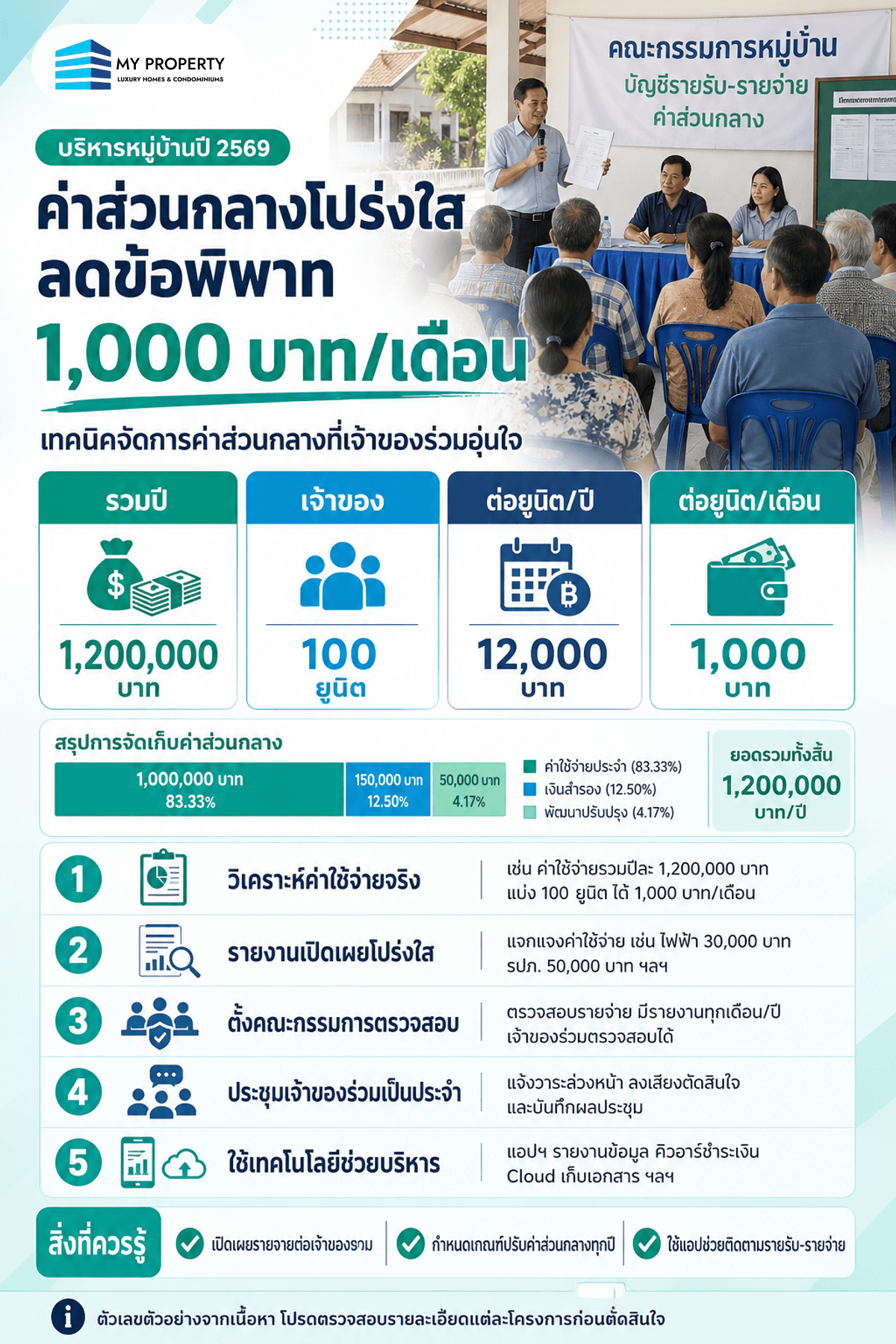
Before determining the common fees, it is necessary to analyze the actual expenses incurred in the estate, such as maintenance costs for public parks, security fees, and common area electricity charges. A report detailing these expenses should be prepared clearly. For example, if the total expenses last year amounted to 1,200,000 baht and there are 100 co-owners, the appropriate common fee should be 12,000 baht per unit per year, or 1,000 baht per month.
The common fees should reflect the comfort and amenities provided by the housing estate. For instance, if the estate offers facilities such as a swimming pool, fitness center, or playground, the common fees may be higher. Additional fees can be set based on the types of amenities available. For example, if there is a swimming pool, the common fee might increase by 200-500 baht per unit per month, depending on maintenance costs.
It is important to establish criteria for adjusting common fees to align with changing expenses in the future. Adjustments may be made annually, considering inflation rates and rising costs. For example, if the inflation rate for the year is 3%, the common fees may be increased accordingly to cover the higher expenses.
Setting appropriate common fees not only ensures fair spending but also promotes good relationships among co-owners within the housing estate.
Preparing reports on common fee expenditures is crucial for ensuring transparency within a housing estate. Reports should include clear details such as utility costs, maintenance expenses, and security-related costs. For example, if a housing estate charges an annual common fee of 1,200 baht per unit and there are 100 co-owners, the total budget would be 120,000 baht. A detailed report should clearly allocate the spending, such as 30,000 baht for utilities, 40,000 baht for maintenance, and 50,000 baht for security expenses.
Disclosure of common fee expenditure information to co-owners should be done regularly through various channels such as email, reports on the estate’s website, or annual meetings. This allows co-owners to review and inquire about the information. For instance, quarterly expenditure reports should be prepared and sent to all co-owners each quarter, detailing the spending and the reasons behind it, ensuring everyone is involved in understanding and monitoring the expenses.
Establishing communication channels for co-owners to ask questions or provide feedback regarding common fee expenditures is essential. A dedicated Line group or a specific website for the estate can facilitate convenient communication. For example, if 20,000 baht is spent on renovating the public park, co-owners can share their opinions or suggestions about material choices or design. This helps foster a sense of ownership and enhances transparency in managing the common fees.
Establishing an internal audit system is crucial for managing common area fees in housing estates to ensure transparency and reliability by 2026, especially in situations where the number of housing estates and the diversity of co-owners are expanding.
One effective method is to set up an internal audit committee composed of elected co-owners. This committee is responsible for auditing the use of common area fees, including regularly preparing financial reports. For example, the committee may produce monthly expenditure reports detailing costs such as maintenance fees, utility expenses, and other charges, allowing co-owners to review and provide feedback.
Preparing annual reports is another way to evaluate the use of common area fees. These reports should include clear information, such as comparisons between the budgeted amounts and actual expenses, as well as the outcomes from the expenditures. For instance, if in 2025 a housing estate budgeted 1,200,000 baht for common area fees but actual expenses were 1,000,000 baht, an explanation should be provided for why the expenses were lower than expected.
Incorporating technology into internal auditing should not be overlooked. Using management software for common area fees that can record and report financial data in real-time allows co-owners to conveniently track information. For example, a system with features enabling co-owners to check expenditure details and participate in discussions helps enhance transparency and confidence in the management process.
Holding joint owner meetings in housing estates is extremely important as it provides an opportunity for homeowners to discuss common area fees and make collective decisions effectively. For example, if there is a proposal to increase the common area fee from 1,500 baht to 2,000 baht, homeowners can express their opinions and suggest appropriate spending plans.
Having a clear meeting agenda helps make the meeting more efficient. The agenda should be communicated at least 7 days in advance. For instance, discussing road repairs within the estate, which may cost around 100,000 baht, along with preparing a clear budget.
In the digital age, using online platforms for joint owner meetings, such as Zoom or Microsoft Teams, allows homeowners who cannot attend in person to participate. For example, if there are 30 homeowner families, an online system can enable those unable to attend to cast their votes, promoting transparency and ensuring all homeowners are involved.
When it comes time to decide on common area fees, homeowners can vote to express their consensus. For example, if there is a proposal to increase the fee to improve facilities like the swimming pool, an official vote should be conducted by gathering opinions from attending homeowners. If 20 homeowners agree, the proposal can proceed.
After the meeting, detailed minutes should be recorded and shared with all homeowners, such as a meeting report including decisions about common area fees. This allows homeowners to clearly review transparency and the decisions made.
In 2026, the adoption of applications to assist in managing common fees has become a popular choice in housing estates. Specialized platforms have been developed to allow co-owners to check common fee expenditure information at any time, increasing transparency in management. For example, the "Home Management" application features allow users to view spending reports, income and expenses, and payment reminders for common fees, making it easier to track payment status.
Storing financial data digitally is another option that helps reduce the hassle of managing documents. Using Cloud Storage systems allows various data such as invoices, receipts, and spending reports to be stored in one place and accessible to co-owners anytime, anywhere. Examples include Google Drive or Dropbox, which enable convenient document sharing among members.
Using social media or Line groups for communication among members in housing estates is a method that facilitates fast and efficient communication regarding common fees. For instance, creating a Line group for the estate allows staff to announce news, meeting information, and common fee payments, reducing unnecessary communication and ensuring accurate information reaches members quickly.
Paying common fees through online channels such as Mobile Banking transfers or QR Code payments allows co-owners to pay conveniently, quickly, and securely. This reduces the hassle of handling cash and helps record data accurately. Examples include using services like KPlus or TrueMoney, which enable immediate payment without the need to visit the estate office.
Building understanding among members in a housing estate regarding the common area fees is very important, as it helps reduce disputes and foster unity within the community, especially in 2026, a year marked by rapid competition and social changes.
Effective communication is the key to creating understanding about common area fees. Members in the estate should have clear communication channels, such as creating a LINE group or Facebook group, so members can inquire and access information at any time. For example, Estate A has set up a LINE group and regularly shares information about the budget usage for common area fees, enabling members to follow and better understand the expenditures.
Presenting clear statistical data about the common area fees helps members see an overview of transparent management. For instance, if the common area fee is 2,500 baht per month per unit, members should receive information on how this expense is allocated, such as 1,000 baht for public park maintenance, 800 baht for security services, and 700 baht for other services. Showing such itemized details helps members understand that the common area fees are reasonable.
Organizing various activities within the estate, such as member meetings to discuss common area fees, social gatherings, or volunteer activities, helps strengthen relationships among members, encouraging the exchange of opinions and building mutual understanding. For example, Estate B holds an annual meeting to discuss the use of common area fees, where all members have the opportunity to express their views, promoting transparency and reducing dissatisfaction within the estate.
Building understanding among members in the estate regarding common area fees requires cooperation and effective communication so that all members feel part of a transparent and fair management process.
Managing and resolving disputes related to common area fees in housing estates is an important matter that should not be overlooked. Such disputes can lead to conflicts among community members, affecting the atmosphere and quality of life within the estate. Therefore, having clear guidelines for handling disputes can help reduce tension and foster cooperation within the community.
There should be a clear system for co-owners to report disputes, whether through online channels or by setting up a complaint box in common areas. For example, creating a form that co-owners can fill out with information and details about the dispute. This system will facilitate easier data collection and status tracking.
Once a dispute is reported, a meeting should be arranged between the co-owners and the estate committee to discuss the issues. The meeting should have clear documentation of information and outcomes. For instance, if there is a dispute regarding unfair allocation of common area fees—such as Co-owner A feeling that they are paying more than their fair share compared to their use of the common facilities—a discussion should be held to find a solution acceptable to all parties.
If negotiations fail to reach a resolution, consider involving a neutral third party or an expert mediator to help settle the dispute. This person’s role is to listen to both sides and propose impartial solutions. For example, engaging a legal professional or an organization specializing in community dispute resolution services.
After agreeing on a resolution approach, the results should be documented and progress continuously monitored to ensure strict compliance. For example, scheduling a review of the implementation every three months so co-owners can closely follow up on the outcomes.
Following these guidelines will help ensure that disputes regarding common area fees in housing estates are resolved effectively and fairly.
In the future, common fee management will increasingly incorporate technology, such as automated payment systems through applications that allow co-owners to conveniently pay their fees without having to visit the office or handle paperwork. Using such systems will reduce the hassle of fee collection and enable efficient tracking of payment statuses.
The disclosure of common fee expenditure will evolve to real-time display, allowing co-owners to view spending information anytime via online platforms. This includes showing remaining balances, monthly expenses, or generating downloadable financial reports, which will enhance transparency and reduce doubts among members.
Moreover, housing estates will develop additional services such as organizing recreational activities or services that add value to the common fees. Special funds can be established to support these activities, such as a fund for public park development. This type of management will help co-owners feel the value of the fees they pay.
Creating cooperation among different housing estates will be another important future trend, such as forming groups to negotiate common fees collectively and sharing experiences and best management practices. This will strengthen common fee management in each community and raise standards.
Future common fee management will need to better respond to members’ needs and feedback by conducting surveys or research to gather opinions on spending and services to be offered. This will help build satisfaction and a stronger sense of belonging among village members.
Managing common area fees in housing estates in 2026 requires transparency and a clear system to prevent potential disputes. Setting appropriate common fees, organizing joint owner meetings, and utilizing technology in management can help ensure smooth and fair administration.
Building understanding and good communication among village members is also an important factor in reducing disputes and fostering good community relationships.
The common area fee is a charge that co-owners must pay to maintain and upkeep the utilities in the housing estate, such as parks, security systems, and cleaning services. Paying this fee is a collective effort to preserve the quality of life within the community.
The common area fee can be calculated in various ways, such as based on the usable area of each house or proportionally according to the number of members in the estate, taking into account maintenance costs and the required budget.
The common area fee assessment should be conducted regularly, for example annually, by reviewing the actual expenses incurred and comparing them with the budget set, to ensure accuracy in setting the fee for the following year.
Disputes about the common area fee can be resolved by establishing a credible central committee to review the issues and find fair solutions for all parties involved. The decisions must be documented and disclosed to the co-owners.
The management of the common area fee in a housing estate is usually the responsibility of the estate’s management committee, which consists of elected co-owners who oversee financial management and various operations of the estate.
Co-owner meetings should be held at least twice a year to provide opportunities to discuss the management of the common area fee, estate improvements, and joint decision-making on various matters, which helps strengthen relationships and understanding within the community.
Was this article helpful?
Hand-picked listings related to this article